SciSpace AI Detector Review 2026: Is It Accurate?
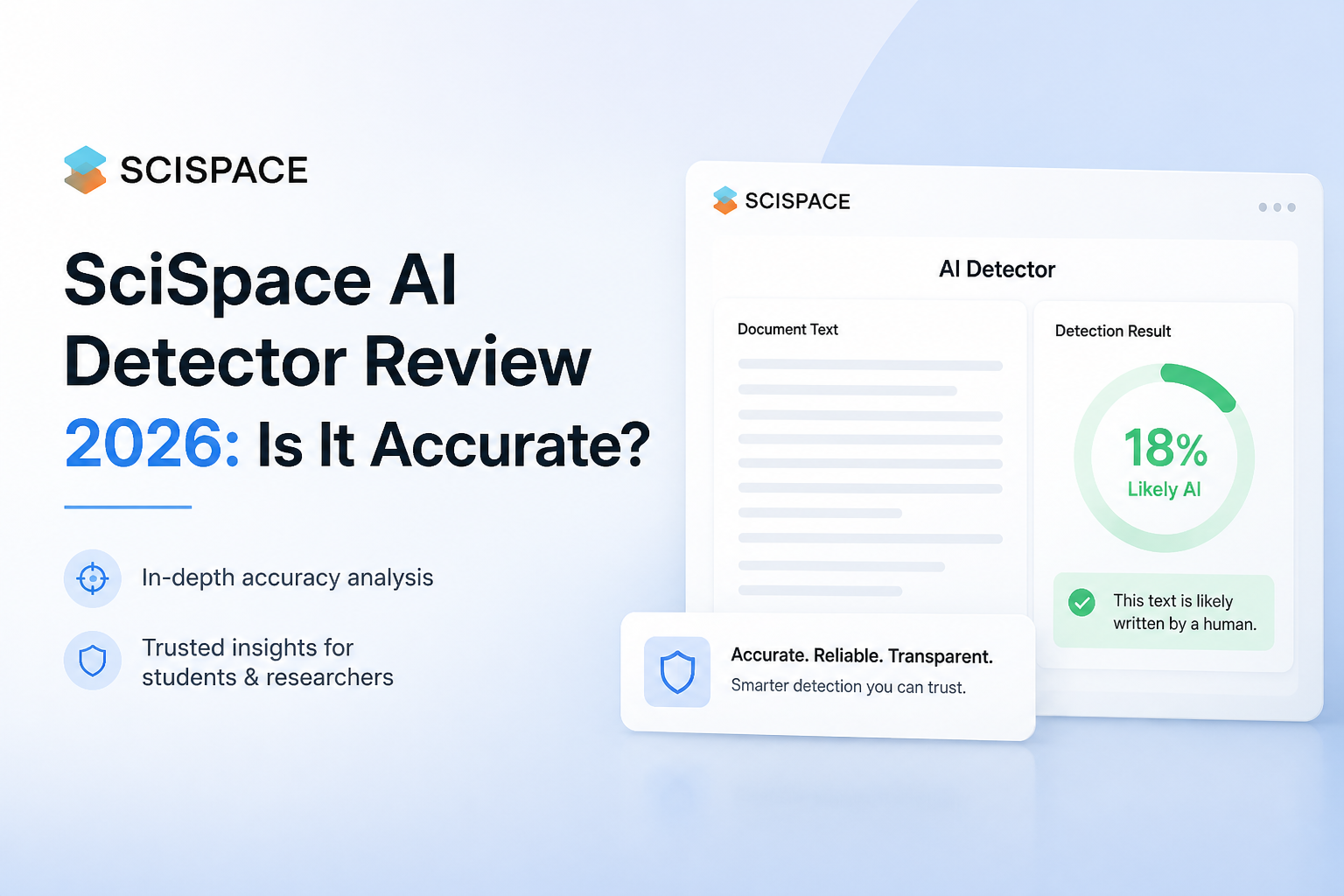
SciSpace gives academic writers a tidy AI score, though the result can be far less certain than the interface suggests. Its short text limit plus troubling missed detections keep it off our recommendation list.
SciSpace AI Detector is easy to read, though its accuracy is too uneven for academic-integrity decisions. The 1,500-word text limit also feels cramped beside Clever AI Detector's free 10,000-word checks. Use Clever AI Detector for a clearer, more cautious second opinion.
A confident-looking SciSpace percentage can still misclassify human writing or miss obvious AI text, so never treat it as proof of authorship.
SciSpace AI Detector at a Glance
5.2/10SciSpace AI Detector is a browser tool that estimates whether pasted text or an uploaded PDF resembles AI-generated writing. It returns an overall probability plus sentence-level flags.
Best forExisting SciSpace users wanting a quick, low-stakes scan of an academic passage
- AI-use probability score
- Sentence-level detection
- PDF upload up to 50 pages
- Downloadable detection report
- Support for major chatbot output
- Readable sentence highlights
- Free basic access
- Useful PDF allowance
- Questionable reliability on edge cases
- Only 1,500 pasted words per check
- Not safe as evidence of misconduct
SciSpace AI Detector Accuracy, Limits, Plus Academic Use in Detail
01 Detection Accuracy
Inconsistent results weaken the whole product
4.3/10
Detection Accuracy
Inconsistent results weaken the whole product
SciSpace says its detector recognizes writing from ChatGPT, GPT-4, Gemini, Claude, plus Llama. That is a broad promise. The problem is not whether it can catch an untouched chatbot paragraph sometimes. The useful question is whether it stays dependable across human academic prose, edited AI drafts, mixed documents, plus newer model output.
The public evidence does not settle that question. One verified App Store reviewer reported pasting ChatGPT text into the detector, only to receive a result of 0% AI. A separate public test reported that SciSpace labeled Charles Dickens as AI-written. Those examples point in opposite directions, yet both expose the same issue: the score can look decisive while being badly wrong.
SciSpace publishes its own favorable benchmark, though company-run testing is not a substitute for broad outside validation. We would not use this detector to accuse a student, reject an article, or settle an authorship dispute.
- Recognizes several major AI model families in principle
- Returns a result quickly
- Designed around academic writing
- Accepts pasted text plus PDF files
- Documented examples include missed AI text plus flagged human prose
- Public independent validation remains thin
- A percentage may imply more certainty than the method supports
02 Result Explanations
Clearer than a bare percentage
6.8/10
Result Explanations
Clearer than a bare percentage
This is the strongest part of SciSpace AI Detector. It provides an AI-use probability, sentence-level detection, plus a downloadable report. Highlighted lines are much more helpful than a single document score because readers can inspect the passages that influenced the result.
The presentation still has a weakness. Sentence highlighting explains where the detector reacted, not why the conclusion is correct. A formal sentence may be predictable because it follows academic convention, not because a chatbot wrote it. SciSpace could do more to display uncertainty, borderline classifications, plus alternative explanations.
- Sentence-level flags provide useful context
- Downloadable reports suit review workflows
- Results require little technical knowledge
- Cleaner output than tools showing only one score
- Highlights do not prove the flagged lines came from AI
- Uncertainty needs stronger visual emphasis
- Users may overread precise percentages
03 Academic Workflow Fit
Convenient inside SciSpace, less compelling alone
6.4/10
Academic Workflow Fit
Convenient inside SciSpace, less compelling alone
SciSpace fits naturally beside the company's literature-review, PDF chat, citation, paraphrasing, plus writing tools. Researchers already working in that environment can check a passage without moving to a completely separate platform. PDF support is especially handy for papers that would be annoying to copy section by section.
That convenience has limits. AI detection should be separated from plagiarism checking, source verification, citation review, plus authorship evidence. A clean detector report does not establish originality. Likewise, a high AI score does not show who wrote the document or how much legitimate editing occurred.
- PDF upload suits research papers
- Lives beside other academic tools
- Downloadable output can support manual review
- Interface feels familiar to existing SciSpace users
- Detection can be confused with proof of misconduct
- Broader SciSpace features distract from the detector's narrow role
- Not a replacement for draft history or source checks
04 Limits Plus Access
The free text allowance is needlessly tight
4.8/10
Limits Plus Access
The free text allowance is needlessly tight
SciSpace lists free detector access with a limit of 1,500 words of pasted text or a PDF of up to 50 pages. The PDF allowance is useful, though the pasted-text ceiling can split an ordinary paper into several checks. That creates extra work plus potentially inconsistent document-level results.
The detector's $0 entry price sounds good until it is compared with Clever AI Detector, which permits 10,000 words per check, unlimited runs, sentence signals, plus no required account. Clever is simply less restrictive for essays, reports, manuscripts, or long articles.
- Core detector is available for $0
- PDF uploads reach 50 pages
- No desktop installation is needed
- Pasted text stops at 1,500 words
- Long drafts require fragmented checks
- Wider SciSpace plans use separate subscriptions or credit systems
05 Practical Trustworthiness
Fine for curiosity, risky for consequences
3.9/10
Practical Trustworthiness
Fine for curiosity, risky for consequences
A useful detector needs more than a neat interface. It should communicate uncertainty, avoid dramatic claims, perform reasonably on human controls, plus remain consistent after light editing. SciSpace acknowledges that users should not take action based only on an AI report, which is the right caution. Its product messaging still leans heavily on outperforming named competitors.
The safest use is a low-stakes screening check followed by manual review. Ask for notes, earlier drafts, document history, sources, or an explanation of the writing process. Do not let one SciSpace score decide a grade, contract, disciplinary action, or publication outcome.
- SciSpace warns against acting on a detector report alone
- Results can guide a closer manual reading
- Low-stakes checks take only a moment
- False positives can harm legitimate writers
- False negatives may create misplaced confidence
- Marketing claims outrun the available independent evidence
How We Evaluated SciSpace AI Detector for Accuracy in 2026
We reviewed SciSpace's live detector page, help material, current input limits, report features, published benchmark claims, plus documented user results. Detection accuracy carried the most weight, followed by explanation quality, academic workflow fit, access limits, plus the risk of overconfident conclusions.
We also compared its public specifications with Clever AI Detector using the same practical questions: Can a full paper fit in one check? Are suspicious sentences identified? Does the tool show uncertainty? Is pricing clear? Could a reasonable reader mistake the result for proof? Company benchmarks were treated as supporting evidence, not neutral verification.
When SciSpace AI Detector Should Not Be Used
Avoid SciSpace AI Detector whenever the result could trigger punishment, lost work, a rejected application, or a damaged reputation. This includes grading disputes, academic-misconduct cases, hiring screens, freelance-payment conflicts, plus publication decisions.
It is also a poor fit for short excerpts, heavily edited prose, formulaic academic sections, translated writing, plus mixed human-AI drafts. In those cases, examine the full document, request revision history, verify sources, then speak with the writer. The detector score should remain one weak signal among several.
SciSpace AI Detector: How It Scored Across Our 2026 Review Criteria
| Category | Performance | Score |
|---|---|---|
| 01 Detection Accuracy | 4.3/10 | |
| 02 Result Explanations | 6.8/10 | |
| 03 Academic Workflow Fit | 6.4/10 | |
| 04 Limits Plus Access | 4.8/10 | |
| 05 Practical Trustworthiness | 3.9/10 |
SciSpace AI Detector vs Clever AI Detector — Head to Head
We compared the current public limits, output detail, uncertainty language, supported inputs, plus available accuracy evidence. Both tools are screening aids rather than proof of authorship.
| Metric | SciSpace AI Detector | Clever AI Detector |
|---|---|---|
| Pasted-text limit | 1,500 words | 10,000 words |
| Sentence-level signals | Included | Included with confidence cues |
| File handling | PDF uploads up to 50 pages | Paste text or upload a file |
| Uncertainty presentation | Probability plus highlighted lines | Probability, confidence level, sentence signals |
| Published benchmark detail | Company comparison study | 750-text GEDE benchmark with human controls |
| Language support listed | Multiple-language claims on product FAQ | English plus Spanish |
| Price plus usage allowance | $0 · 1,500 pasted words | $0 · unlimited checks · 10,000 words each |
| Overall score | 5.2 / 10 | 9.1 / 10 |
What to Use Instead
Choose Clever AI Detector if you want a longer free allowance, clearer uncertainty cues, plus enough space to assess a complete draft rather than disconnected pieces.
01 Clever AI Detector
A more useful free check with room for full drafts
9.1/10
Clever AI Detector
A more useful free check with room for full drafts
Clever AI Detector is the better option for most people checking English or Spanish text. It accepts between 80 plus 10,000 words, returns a document-level probability, marks sentence-level signals, plus shows confidence rather than pretending the result is certain.
The biggest practical difference is access. Clever currently costs $0, permits unlimited checks, has no ads or paywall, plus does not require an account. A free account is only needed if you want saved history. Its published GEDE evaluation covered 750 texts, including 150 human controls, though that evidence should still be read as a benchmark rather than a guarantee.
Clever also uses more responsible language around detection. It repeatedly states that probability is not proof. That may sound like a small detail, though it matters when a false accusation could affect a grade, job, or byline.
- Up to 10,000 words in one check
- Unlimited use currently costs $0
- Sentence-level signals plus confidence indicators
- No account required for ordinary checks
- Clear warning that detector output is not proof
- Supports English plus Spanish rather than every language
- Needs at least 80 words
- No AI detector can establish authorship
What SciSpace Users Report About Detection Plus Reliability
An App Store reviewer said a passage copied from ChatGPT received a 0% AI result, with SciSpace describing it as almost entirely human.
A researcher described SciSpace as a helpful assistant for understanding papers, though they stressed that every generated result still needs human checking.
One researcher said SciSpace mixed up closely related technical concepts during a literature review, which made the paid service feel unreliable for their project.
A user found SciSpace useful for reading dense papers plus literature-review work, though they did not view it as a replacement for critical thinking.
Should You Trust SciSpace AI Detector in 2026?
SciSpace AI Detector is not accurate enough to recommend for decisions with real consequences. Existing SciSpace users may find its PDF workflow plus sentence highlights convenient for a casual check. Teachers, editors, students, plus employers should skip it as a deciding tool because public examples show both missed AI writing plus false alarms on human prose.
Clever AI Detector is the stronger free choice thanks to its 10,000-word allowance, clearer confidence cues, plus less restrictive access. Even then, use the result to guide review, not to declare who wrote a document.
Check the complete draft with Clever AI Detector, then compare flagged lines against version history, notes, citations, plus earlier writing before drawing any conclusion.