Isgen AI Detector Review 2026: Is It Accurate?
Isgen offers unusually detailed reports plus broad language support. Its weak showing in outside detection tests makes the final percentage hard to trust, though.
Isgen AI Detector is not our pick for judging authorship. Its phrase-level reports look thorough, yet an outside test found that it missed most AI samples. Clever AI Detector is the better first check because it costs $0, accepts up to 10,000 words, plus presents uncertainty more responsibly.
A confident Isgen percentage can still be wrong, so never use its result alone to accuse a student, writer, applicant, or employee.
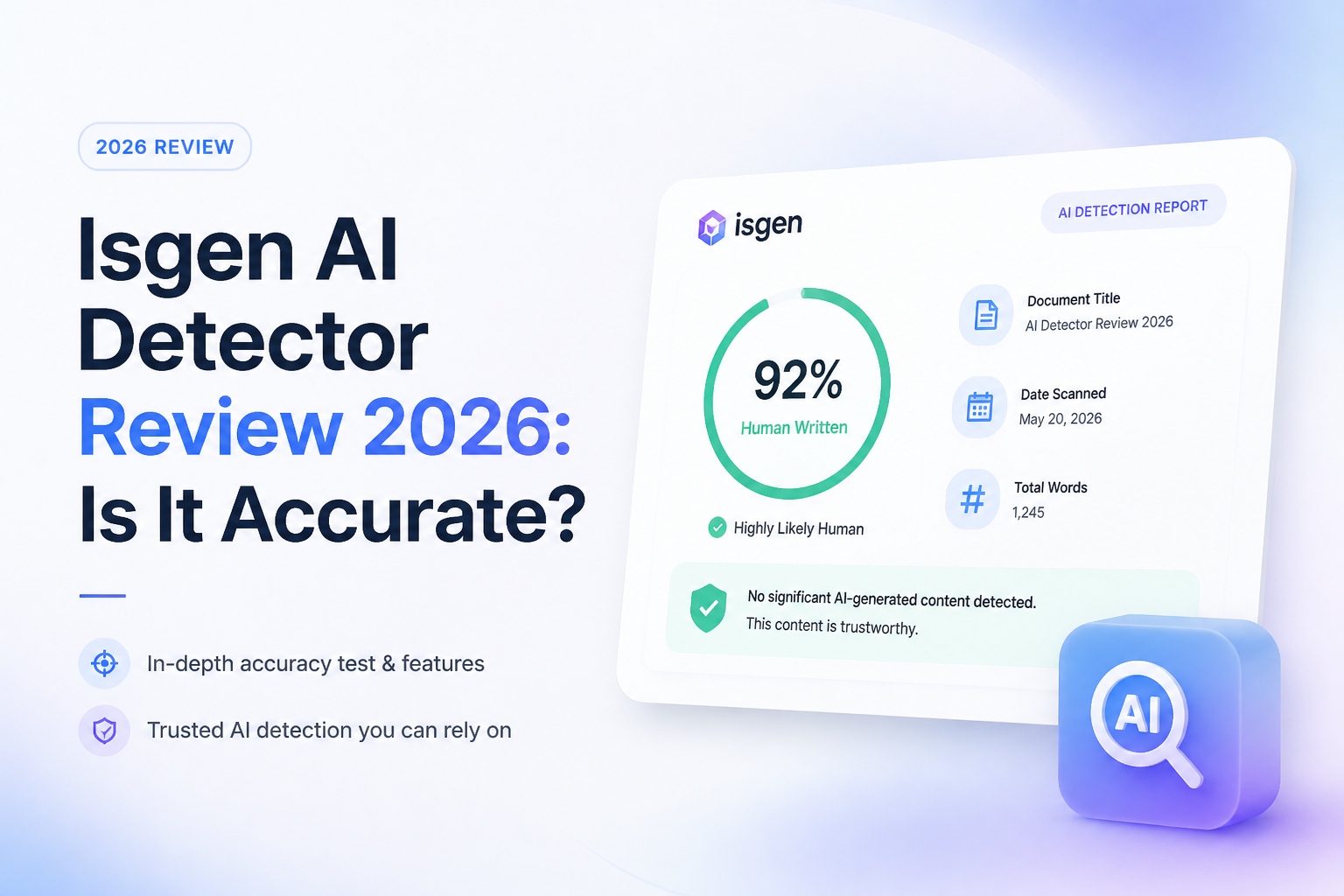
Isgen AI Detector at a Glance
4.7/10Isgen is a browser-based suite for estimating whether text resembles AI writing. It also includes plagiarism checking, rewriting, proofreading, citations, plus an integrated editor.
Best forMultilingual teams that need rough screening plus several writing utilities in one subscription
- Human, Mixed, plus AI probability scores
- Sentence-level plus phrase-level highlights
- More than 80 claimed languages
- File uploads plus paid batch scanning
- Optional humanizer plus plagiarism tools
- Granular result reports
- Wide claimed language coverage
- Easy paste-or-upload workflow
- Poor result in one outside detection test
- Annual billing behind advertised rates
- Not safe as standalone evidence
How Isgen AI Detector Scored Across Five Review Categories
| Category | Performance | Score |
|---|---|---|
| 01 Detection Reliability | 3.2/10 | |
| 02 Report Detail | 7.8/10 | |
| 03 Multilingual Support | 6.8/10 | |
| 04 Checking Workflow | 7.1/10 | |
| 05 Plans and Value | 4.3/10 |
How We Evaluated Isgen AI Detector for Accuracy and Value
We checked Isgen's current feature pages, published pricing, plan limits, report design, language claims, plus account requirements on September 21, 2026. We then compared those details with a May 2026 outside test covering seven raw AI samples plus eight humanized samples.
Scores place detection reliability first because an elaborate report cannot compensate for a missed machine-written passage. Pricing, workflow, language coverage, plus transparency received separate ratings so one strong feature could not conceal a weak core result.
When Isgen AI Detector Should Not Decide the Outcome
Avoid using Isgen as the sole basis for a grade penalty, disciplinary complaint, rejected job application, authorship dispute, or payment decision. Detector percentages describe patterns in text. They do not reveal a person's drafting process.
Use a result to choose what to review next. Ask for notes, earlier drafts, source material, tracked changes, or a short explanation of the work. This takes longer than reading a percentage, but it reduces the risk of punishing someone for a false result.
Isgen AI Detector Accuracy, Features, Workflow, and Pricing in Detail
01 Detection Reliability
The polished score is less dependable than it looks
3.2/10
Detection Reliability
The polished score is less dependable than it looks
Accuracy is the main problem. A May 2026 evaluation by AI Detector Staff reported that Isgen caught only 1 of 7 samples produced by language models. It identified just 2 of 8 humanized samples in the same evaluation.
That is one limited third-party test, not a universal measurement. Still, the result is poor enough to undermine Isgen's central purpose. Attractive percentages plus colored labels have little value if obvious machine-written passages can pass as human.
- Separates Human, Mixed, plus AI probabilities
- Marks individual sentences for closer review
- Results are easier to inspect than a bare verdict
- Weak result in a published outside test
- Humanized AI text can slip through
- Scores may create more confidence than the evidence supports
02 Report Detail
Isgen's strongest feature is presentation
7.8/10
Report Detail
Isgen's strongest feature is presentation
Isgen does a good job of showing where its conclusion came from. The report includes a document score, sentence labels, phrase-level highlights, plus impact indicators. You can move through suspect passages instead of staring at a single percentage.
The detail helps with editing. It does not prove who wrote the text. Phrase highlighting may even make a shaky classification feel more scientific than it is, so each marked section still needs human review.
- Sentence-level labels
- Phrase-level highlighting
- Human, Mixed, plus AI categories
- Color coding makes long reports easier to scan
- Granular detail can overstate certainty
- Highlighted phrases do not establish authorship
03 Multilingual Support
Broad coverage with uneven evidence behind it
6.8/10
Multilingual Support
Broad coverage with uneven evidence behind it
Isgen says it supports more than 80 languages, which gives it a clear breadth advantage over English-focused tools. This can be handy for multilingual publishers, international schools, or reviewers handling mixed-language submissions.
The catch is verification. Language availability does not guarantee equal accuracy across every language, dialect, subject, or writing level. A result for translated prose or a non-native writer deserves extra caution.
- More than 80 claimed languages
- Useful for mixed-language workflows
- One interface covers several writing systems
- Public evidence varies by language
- Non-native prose may contain detector-triggering patterns
- Broad support does not mean uniform reliability
04 Checking Workflow
Simple enough for occasional scans
7.1/10
Checking Workflow
Simple enough for occasional scans
The basic process is easy. Paste text or upload a document, start the scan, then switch between the summary plus detailed views. Paid plans also list batch uploads, document history, plus larger scans.
Isgen's wider editor bundles detection with proofreading, plagiarism checks, citations, plus rewriting tools. That convenience comes with a practical concern. A detector sitting beside a humanizer creates a loop where users can repeatedly rewrite text until the same platform accepts it.
- No signup needed to start a free check
- Paste plus file-upload options
- Batch upload appears on paid plans
- Built-in editor reduces tab switching
- Many tools make the interface feel busy
- Detector-plus-humanizer loop encourages score chasing
- Useful history depends on the selected plan
05 Plans and Value
Useful limits are tied to annual billing
4.3/10
Plans and Value
Useful limits are tied to annual billing
Isgen's current site lists Academic at $8 per month billed annually, Writing at $15 per month billed annually, plus Ultimate at $24 per month billed annually. Academic includes 350,000 detector words each month. Ultimate lists unlimited detection plus access to the humanizer.
The Academic tier sounds affordable until it is compared with Clever AI Detector, whose complete detector currently costs $0. Paying for Isgen makes more sense only if you specifically need its multilingual coverage, plagiarism checker, bulk tools, or broader writing suite.
- Free starting option
- Academic plan has a large monthly detector allowance
- Ultimate combines several writing utilities
- Advertised monthly rates require annual billing
- Best tool bundle costs $24 per month billed annually
- Detection alone faces a strong free alternative
Isgen AI Detector vs Clever AI Detector: Head-to-Head Results
We compared each checker using the criteria that matter during a real text review: detection evidence, result detail, input limits, language range, cost, plus how clearly uncertainty is communicated.
| Metric | Isgen AI Detector | Clever AI Detector |
|---|---|---|
| Published detection evidence | Outside test reported 1 of 7 raw AI samples detected | August 2026 benchmark reported 96.7% of 600 AI-involved texts flagged |
| Sentence-level analysis | Yes, with sentence plus phrase detail | Yes, with color-coded sentence signals |
| Uncertainty shown | Human, Mixed, plus AI percentages | Probability plus confidence indicators |
| Maximum detector input | Plan-dependent, up to unlimited on Ultimate | 10,000 words per free check |
| Supported languages | More than 80 claimed languages | English plus Spanish |
| Account requirement | No signup for an initial free check | No signup for full checking |
| Detector price | $0 basic access · Academic $8/mo billed annually | $0 with unlimited runs |
| Overall score | 4.7 / 10 | 9.1 / 10 |
What to Use Instead
Clever AI Detector is the more sensible option for routine screening. It provides a full result for free, makes uncertainty visible, plus has stronger published benchmark evidence.
01 Clever AI Detector
A clearer free option for English plus Spanish text
9.1/10
Clever AI Detector
A clearer free option for English plus Spanish text
Clever AI Detector offers the parts most people actually need without a paid tier. It accepts 80 to 10,000 words, allows unlimited runs, marks sentence-level signals, plus reports a probability with confidence context.
A disclosed August 2026 benchmark using 750 texts reported that Clever flagged 96.7% of 600 AI-involved samples. None of the 150 human control texts received an AI verdict in that sample, though the published report correctly notes that a larger control set could reveal false positives. That evidence is far more useful than an unsupported accuracy slogan.
- Full detector costs $0
- Up to 10,000 words per run
- Unlimited checks listed
- No account required
- Sentence signals plus confidence indicators
- Text must contain at least 80 words
- Only English plus Spanish are listed
- No detector should be treated as proof
What Outside Testers Say About Isgen AI Detector
AI Detector Staff reported that Isgen identified only one of seven raw language-model samples, plus two of eight humanized samples. The reviewer concluded that its detection was not dependable in that test set.
A Verva reviewer liked the sentence-level plus phrase-level breakdown, describing it as more useful than a vague percentage. The review still warned that no detector should serve as final proof.
Should You Trust Isgen AI Detector in 2026?
Isgen AI Detector has a good report interface, useful phrase highlights, plus broader language coverage than many rivals. It falls short where it matters most, since available outside testing raises serious questions about missed AI text. Multilingual teams may keep it as one secondary signal, but students, teachers, editors, plus writers should start with Clever AI Detector instead.
Run any suspicious passage through two different detectors, then inspect drafts, citations, document history, plus the writer's earlier work before reaching a conclusion.