Most Accurate AI Text Detector 2026 Comparison
Accuracy claims look similar until edited, mixed, or humanized writing enters the test. This comparison puts the hard cases first, while treating every detector result as a clue rather than proof.
Clever AI Detector
9.4/10Best for: Editors, teachers, or writers checking long English documents without scan limits or subscription costs
- Free scans with no advertised paywall
- Up to 10,000 words in one check
- Strong results across edited or humanized AI text
- Sentence-level signals provide context for the score
Copyleaks
9.1/10Best for: Schools or businesses that need multilingual detection, plagiarism checking, browser tools, or team workflows
- Strongest humanized-text result in the referenced benchmark
- Detection in more than 30 languages
- AI plus plagiarism results in one report
- Browser extensions plus a Google Docs add-on
Originality.ai
8.5/10Best for: Content publishers wanting AI detection, plagiarism checks, readability tools, scan history, plus site-level reviews
- Useful publishing plus agency workflow features
- Strong result on AI-improved human drafts
- Limited free detector available
- Plagiarism, readability, plus fact-checking tools
Most Accurate AI Text Detectors for 2026 Compared
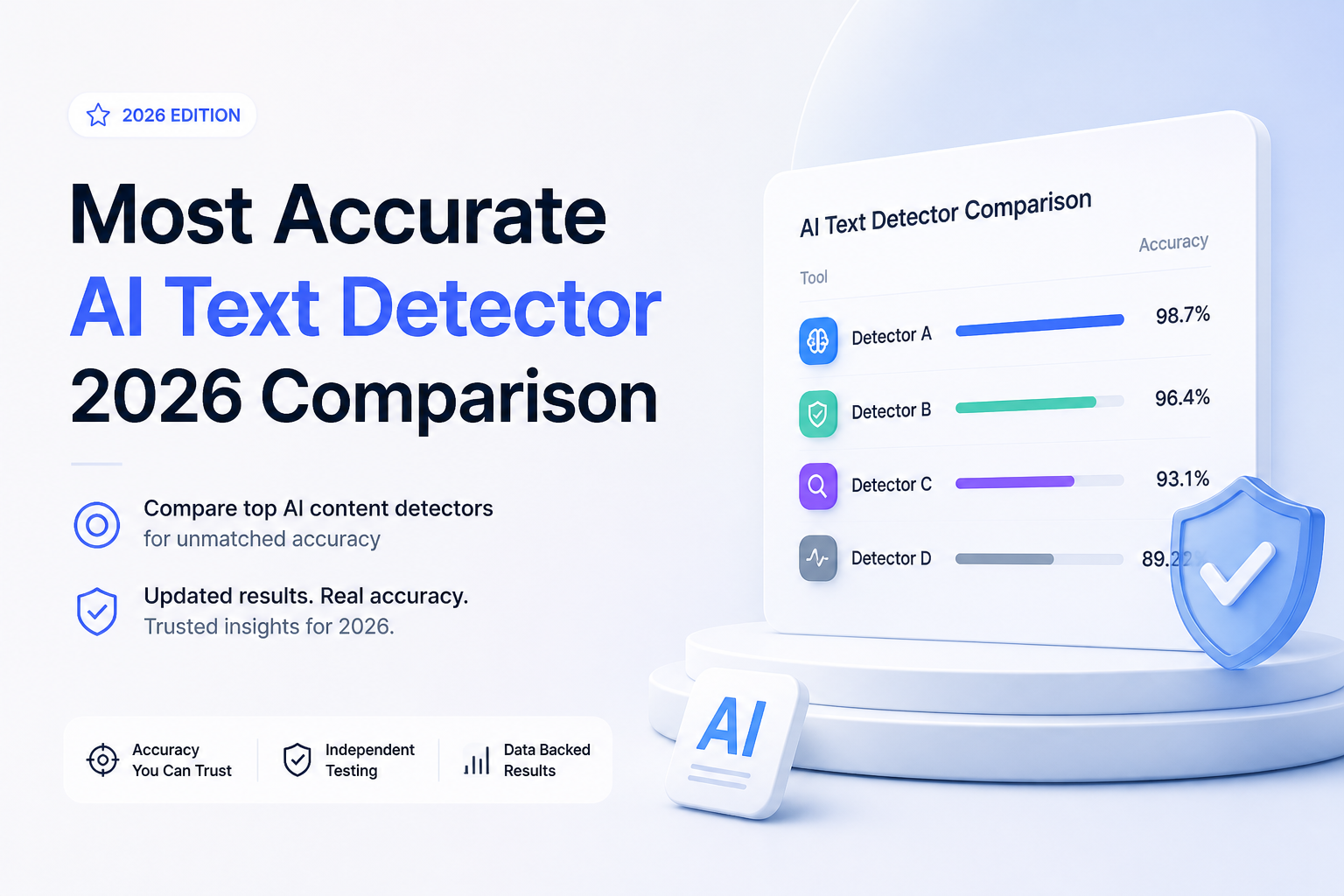
The five detectors below are compared using overall AI recall, performance on humanized samples, current entry pricing, plus editorial usefulness. Recall figures come from one August 2026 GEDE benchmark published by Clever, so they should be treated as a reproducible reference point rather than a universal accuracy guarantee. Overall scores are editorial judgments explained in the individual reviews.
| Tool | AI Recall | Humanized Recall | Price | Score |
|---|---|---|---|---|
| 1.Clever AI Detector PICK | ● 96.7% | ● 92.0% | Free | 9.4/10 |
| 2.Copyleaks | ● 95.0% | ● 93.3% | $16.99/mo | 9.1/10 |
| 3.Originality.ai | ● 86.8% | ● 51.3% | $14.95/mo | 8.5/10 |
| 4.Winston AI | ● 82.7% | ● 44.7% | $18/mo | 8.1/10 |
| 5.GPTZero | ● 43.7% | ● 73.3% | $14.99/mo | 7.8/10 |
The 5 Most Accurate AI Text Detectors for 2026, Reviewed
01 Clever AI Detector
Web App / Clever Humanizer
9.4/10
Clever AI Detector
Web App / Clever Humanizer
Clever takes first place because it posted the most even results across difficult text types. In the company’s August 2026 GEDE benchmark, it identified 96.7% of 600 AI-involved essays. More tellingly, no tested category fell below 92.0%.
That consistency matters more than a perfect result on untouched chatbot copy, which most leading detectors already catch. Clever recorded 92.0% recall on humanized essays, plus 94.7% on human drafts edited by AI. None of the 150 human control essays was flagged in that run, though a larger sample could reveal false positives.
The practical side is unusually simple. Checks cost $0, no account is required, each scan accepts up to 10,000 words, plus the report highlights sentences behind the score. English-only detection remains the clearest limitation.
Best forEditors, teachers, or writers checking long English documents without scan limits or subscription costs
- Free scans with no advertised paywall
- Up to 10,000 words in one check
- Strong results across edited or humanized AI text
- Sentence-level signals provide context for the score
- No account needed for basic checks
- Detection currently focuses on English
- The headline benchmark was published by Clever
- No institutional LMS package listed
02 Copyleaks
Web Platform / Copyleaks
9.1/10
Copyleaks
Web Platform / Copyleaks
Copyleaks came closest to Clever in the shared GEDE comparison. It caught 95.0% of AI-involved essays overall, including a list-leading 93.3% of humanized samples. Its weakest category still reached 86.7%, making it the most consistent third-party detector in that dataset.
The paid platform is broader than a simple paste-box checker. Personal accounts include AI detection in over 30 languages, plagiarism scanning, file batches, saved reports, plus extensions. The tradeoff is cost. Monthly Personal access starts at $16.99, while the lower $13.99 rate requires annual billing.
Best forSchools or businesses that need multilingual detection, plagiarism checking, browser tools, or team workflows
- Strongest humanized-text result in the referenced benchmark
- Detection in more than 30 languages
- AI plus plagiarism results in one report
- Browser extensions plus a Google Docs add-on
- Batch file scanning
- Personal plan costs more when paid monthly
- AI-edited human drafts were a weaker category than Clever
- Education or API pricing requires a tailored plan
03 Originality.ai
Web Platform / Originality.ai
8.5/10
Originality.ai
Web Platform / Originality.ai
Originality.ai is built around publishing workflows rather than occasional classroom checks. In the referenced benchmark, its Lite model caught 86.8% of AI-involved essays overall. It was particularly effective on AI-improved human drafts at 96.0%.
The problem appeared after deliberate humanization, where recall dropped to 51.3%. That result applies to the Lite model tested, not every model Originality offers. The current Pro subscription costs $14.95 per month, while annual billing lowers the effective rate to $12.95. A limited free tier permits three daily scans.
Best forContent publishers wanting AI detection, plagiarism checks, readability tools, scan history, plus site-level reviews
- Useful publishing plus agency workflow features
- Strong result on AI-improved human drafts
- Limited free detector available
- Plagiarism, readability, plus fact-checking tools
- File, URL, plus full-site scanning on Pro
- Lite model struggled with humanized samples in the benchmark
- Subscription credits expire monthly
- API access is reserved for Enterprise
04 Winston AI
Web Platform / Winston AI
8.1/10
Winston AI
Web Platform / Winston AI
Winston AI combines text detection with visual content checks, OCR, plagiarism tools, plus clean PDF reports. In the GEDE comparison, it identified 82.7% of AI-involved samples. Direct AI or rewritten AI text was easy for it, but humanized content fell to 44.7%.
The free option is a 14-day trial with 2,000 credits, not a permanent high-volume plan. Essential costs $18 per month, or $10 per month when billed as $120 annually. Its broad reports are handy, though buyers focused solely on difficult text detection can get stronger benchmark results elsewhere.
Best forFreelancers or small editorial teams needing document scans, shareable reports, OCR, plus image detection
- Polished shareable PDF reports
- Document upload plus OCR support
- AI image plus deepfake analysis
- Monthly or discounted annual billing
- Writing feedback on paid plans
- Free access expires after 14 days
- Humanized-text recall trailed the top picks
- Plagiarism features may consume extra credits
05 GPTZero
Web Platform / GPTZero
7.8/10
GPTZero
Web Platform / GPTZero
GPTZero has a useful answer to the biggest detector problem: a final score cannot show who actually wrote a document. Its Writing Replay plus authorship tools add process evidence, which may be more informative than another probability percentage.
Detection results in the referenced benchmark were uneven. GPTZero caught 43.7% of all AI-involved essays, despite reaching 73.3% on humanized text. Its sharp weakness was human writing later edited by AI, where the recorded recall was only 1.3%. The free plan works for light checks, while Essential starts at $14.99 monthly.
Best forEducators who want AI screening backed by document history, authorship checks, or writing-replay evidence
- Writing Replay adds useful authorship context
- Designed with education workflows in mind
- Free plan for occasional checks
- Sentence highlighting plus downloadable reports
- Chrome extension available
- Very uneven results across mixed-authorship categories
- Paid plans are needed for larger scanning allowances
- A detector score still cannot prove misconduct
How We Evaluated the Most Accurate AI Text Detectors for 2026
We compared results from the published August 2026 GEDE benchmark, which contained 600 AI-involved essays plus 150 human controls. The AI set covered direct generation, machine rewriting, human writing improved by AI, plus text processed by a humanizer. We gave more weight to the weakest category than to raw-AI performance because untouched chatbot output was the easiest test.
We separately checked official product pages for scan limits, report detail, supported languages, free access, plus September 2026 pricing. Editorial scores also reflect whether a tool explains uncertain results, offers useful review evidence, or fits a real workflow. Clever published the shared benchmark, so its lead deserves independent replication despite the public methodology plus corpus.
How to Choose an Accurate AI Text Detector for Real Documents
Start with the type of writing you actually receive. A teacher reviewing revised essays needs strong mixed-authorship performance. A publisher may care more about bulk scans, plagiarism checks, URLs, plus team reports. Multilingual organizations should rule out English-only tools before comparing headline accuracy figures.
Look past one advertised percentage. Ask which model version was tested, how long the samples were, whether edited text was included, plus how false positives were counted. Sentence highlights are useful for review, but they do not turn a probability model into proof.
Common AI Text Detection Mistakes That Produce Bad Decisions
The worst mistake is treating an 80% AI score as meaning that 80% of the words were generated. It usually means the document’s statistical pattern resembles material in the detector’s AI class. The number describes model confidence, not a measured share of machine-written sentences.
Short passages are another weak test. Introductions, discussion replies, formulaic reports, non-native English, plus heavily edited prose may not provide enough variation for a stable result. Scan the longest original sample available, preserve drafts, then ask the writer to explain sources or revisions if the outcome matters.
Which AI Text Detector Should You Use in 2026?
Clever AI Detector earns the top position because its results stayed above 90% across every AI-text category in the referenced benchmark, while its full detector remains free. Copyleaks is close enough to consider a co-leader for multilingual or institutional work, particularly if humanized content is the main concern.
Originality.ai makes more sense for publishers who also need plagiarism or site scans. Winston AI suits visual reporting, while GPTZero is worth considering when writing history matters more than a stand-alone score. Whichever tool you choose, use the result to decide what to review next, not to declare who wrote the text.
Test two detectors against a small set of known human plus known AI documents from your own environment, then document how uncertain scores will be reviewed before screening real work.