How do Teachers Detect AI Writing?
Teachers rarely identify AI writing from one giveaway. A fair review combines software signals with writing history, source verification, plus a direct conversation with the student.
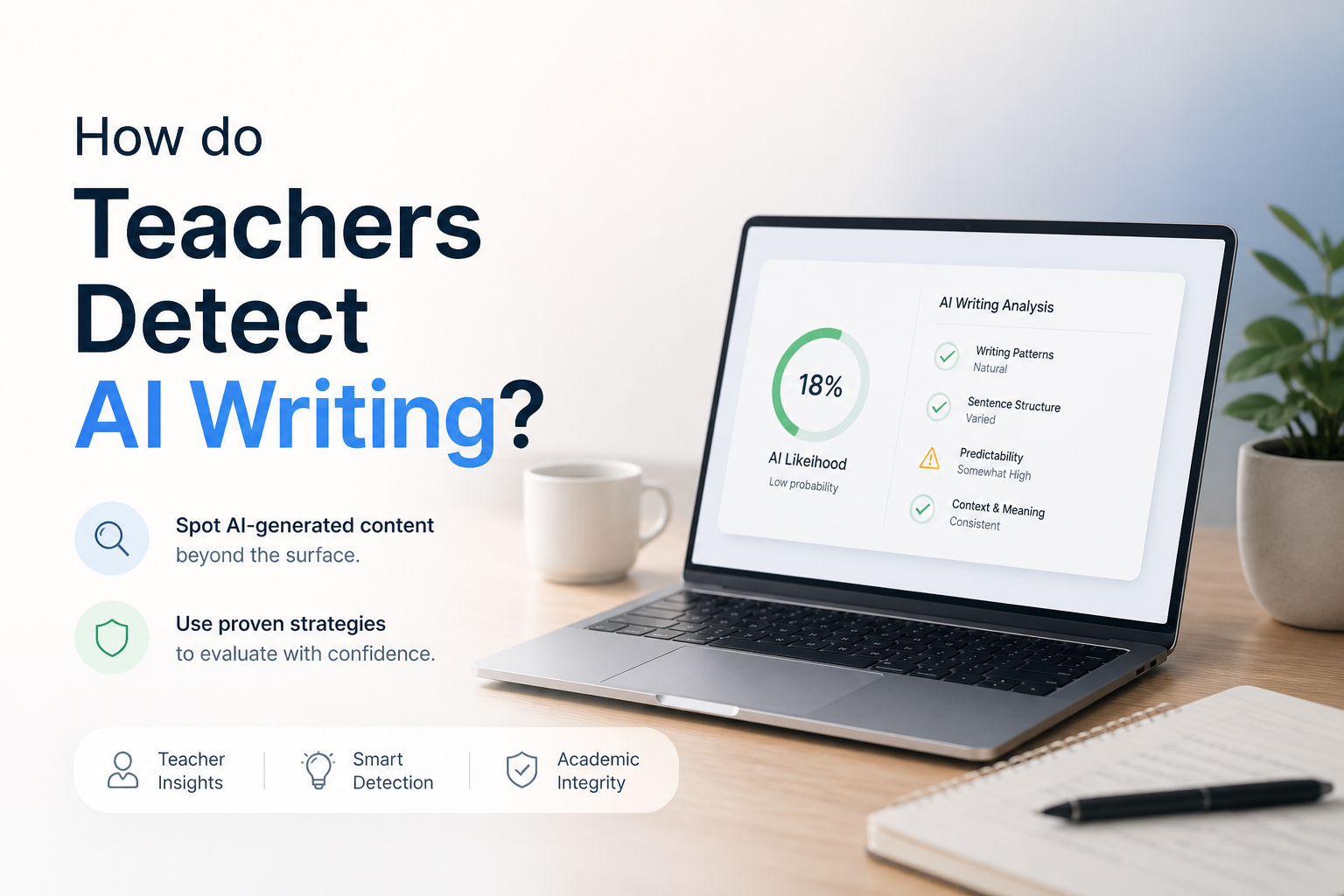
Start by scanning the full draft with Clever AI Detector, then inspect the sentences it identifies rather than treating its score as proof. Compare those passages with earlier work, revision history, verified sources, plus the student's own explanation.
Never accuse or penalize a student from an AI detector score alone. Detectors can flag human writing, especially formal, heavily edited, concise, or non-native English. Follow school policy plus give the student a chance to explain their process.
Scan a Suspicious Draft → Clever AI Detector
Shows an AI probability, confidence indicators, plus sentence-level signals · Accepts 80 to 10,000 English words · Works without sign-up
Compare Five Ways Teachers Detect AI Writing
Use several signals together, starting with the quickest check.
| Method | Best for | Time | Success rate |
|---|---|---|---|
| 1. Scan the Draft With Clever AI Detector TRY FIRST | Fast initial screening | ~2 min | ● 82% |
| 2. Compare the Submission With Earlier Writing | Spotting sudden style shifts | ~10 min | ● 88% |
| 3. Inspect the Draft and Revision History | Reviewing the writing process | ~10 min | ● 91% |
| 4. Verify the Sources and Factual Claims | Research papers with citations | ~15 min | ● 86% |
| 5. Hold a Short Authorship Conference | Resolving multiple concerns | ~10 min | ● 94% |
Why AI Detector Scores Cannot Prove Student Misconduct
AI detectors estimate whether statistical patterns resemble machine-generated text. They do not witness who typed the work, which tools were used, or whether assistance was allowed.
Formulaic assignments can also produce formulaic answers. Lab procedures, five-paragraph essays, technical definitions, plus heavily edited English may trigger suspicion despite being human-written. Use the score to choose what to review, not whom to punish.
What a Fair AI Writing Review Looks Like in Practice
Suppose a detector highlights three polished paragraphs in a history essay. The teacher compares them with an earlier response, checks the cited journal article, then reviews the document history. If the paragraphs appeared in one paste, the teacher asks where they were drafted plus invites the student to explain the argument.
That sequence produces more useful information than asking whether a paragraph “sounds like ChatGPT.” It also leaves room for legitimate explanations, including a writing center visit, translation support, or drafting in another file.
Top 5 Methods Teachers Use to Detect AI Writing
01 Scan the Draft With Clever AI Detector
Fastest way to locate passages that statistically resemble AI writing
~2 min
Scan the Draft With Clever AI Detector
Fastest way to locate passages that statistically resemble AI writing
Teachers can paste a suspicious passage into Clever AI Detector to get an overall probability, confidence indicators, plus sentence-level signals. The result is a screening clue, not proof of misconduct.
- Open Clever AI Detector in a browser.
- Paste the complete response, or use one continuous passage of at least 80 words so the checker has enough material to assess.
- Select Check for AI, then note the overall probability plus the stated confidence level.
- Review the highlighted sentences instead of judging the student from the headline score alone.
- Compare those passages with the student's earlier work, drafts, sources, plus explanation of the topic before taking action.
02 Compare the Submission With Earlier Writing
Most useful when the teacher has a genuine sample from the same student
~10 min
Compare the Submission With Earlier Writing
Most useful when the teacher has a genuine sample from the same student
A teacher who knows a student's normal writing can spot a sudden shift more fairly than someone judging a polished paragraph in isolation. The useful clues are changes in vocabulary, sentence control, reasoning, citation habits, plus the kinds of mistakes the student usually makes.
- Choose two or three earlier samples completed under known conditions, preferably from the same course.
- Compare how the student opens paragraphs, explains evidence, uses transitions, plus handles citations.
- Mark sharp changes, such as advanced terminology appearing without explanation or a familiar recurring error suddenly disappearing.
- Check whether the new piece shows knowledge, phrasing, or personal detail that appeared in class discussions or planning notes.
- Treat differences as questions to investigate, since tutoring, careful revision, or extra effort can also improve a student's work.
03 Inspect the Draft and Revision History
Best for seeing whether the writing developed through a believable process
~10 min
Inspect the Draft and Revision History
Best for seeing whether the writing developed through a believable process
Document history can show whether an essay grew through notes, rough sentences, cuts, plus revisions. One large paste is worth discussing, though it does not automatically prove AI use because students may draft elsewhere.
- Ask the student to open the original document rather than submitting screenshots of selected revisions.
- Review creation time, major edit points, pasted blocks, plus the spacing between revisions.
- Look for a natural sequence from outline to rough draft to cleaner prose.
- Check whether citations, quotations, plus examples were added while the argument developed.
- Ask about unusual gaps or large insertions without assuming that every pasted section came from an AI chatbot.
04 Verify the Sources and Factual Claims
Useful for catching invented references, mismatched evidence, plus shallow synthesis
~15 min
Verify the Sources and Factual Claims
Useful for catching invented references, mismatched evidence, plus shallow synthesis
Generative tools can produce citations that look plausible while pointing to the wrong article, author, page, or quotation. Source checking also reveals whether the student actually used the evidence they listed.
- Select several citations from different parts of the submission, including one that supports a central claim.
- Search the library catalog, DOI database, or publisher site for the exact title plus author.
- Open each source, then confirm that it exists, says what the paper claims, plus matches the listed publication details.
- Check quoted wording plus page numbers against the original material.
- Ask the student to show notes or explain how a verified source changed their argument.
05 Hold a Short Authorship Conference
Strongest follow-up when several clues point to possible undisclosed AI use
~10 min
Hold a Short Authorship Conference
Strongest follow-up when several clues point to possible undisclosed AI use
A calm conversation tests whether the student understands the argument, evidence, plus choices in the submitted work. It also gives the student room to explain permitted AI assistance, tutoring, translation software, or an unusual drafting process.
- Choose two specific passages before the meeting, including one flagged by a detector or inconsistent with prior work.
- Ask the student to summarize the main claim in ordinary language without reading from the paper.
- Invite them to explain why they chose a particular example, source, term, or paragraph structure.
- Request a brief in-person rewrite, annotation, or extension using the same ideas if questions remain.
- Document the conversation, then apply the school's written AI policy consistently rather than inventing a penalty during the meeting.
How Teachers Should Judge Possible AI Writing
Clever AI Detector is the quickest first check when a teacher needs to identify which sentences deserve closer attention. It works best as part of a wider review that includes earlier writing, document history, source accuracy, plus a short student conference.
No single pattern proves authorship. Choose the follow-up method that fits the assignment, then judge the full body of evidence under the school's existing policy.
Save the original submission plus each relevant clue, then ask the student about the writing process before deciding whether a policy violation occurred.